2000 – 2005

Before the agents,
there was C.

Neural nets on Pentiums. TSR hacks in DOS. TCP/IP stacks on microcontrollers. A collection of programs and writing from a time when compilation was the test suite and Stack Overflow didn't exist.

Built with nothing
but a compiler and a deadline.

Academic projects from BMS College of Engineering, Bangalore. Each one built from scratch — no npm install, no pip, no frameworks. Just specs, manuals, and stubbornness.

2004
TCP/IP Stack & HTTP Server on 8051
Final year project. Implemented a lightweight TCP/IP stack and HTTP server on an 8051 microcontroller for remote data access. Bare metal networking on a chip with 128 bytes of RAM.
C8051TCP/IPHTTPEmbedded
↓ dgp.zip (270 KB)
2003
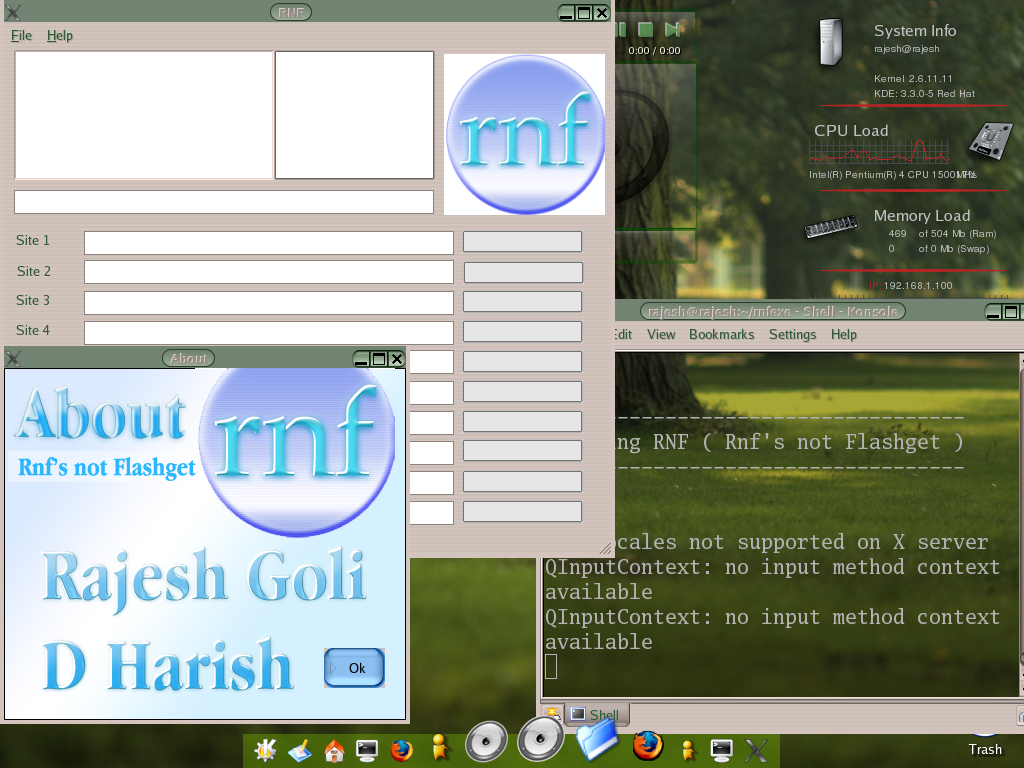
RNF (RNF is Not Flashget)
A download manager with HTTP parsing, socket programming, multithreaded downloads, and a Qt GUI. Recursive acronym because it was 2003 and GNU was cool.
C++QtSocketsMultithreadedLinux
↓ rnf.zip (157 KB)
RNF download manager
2003
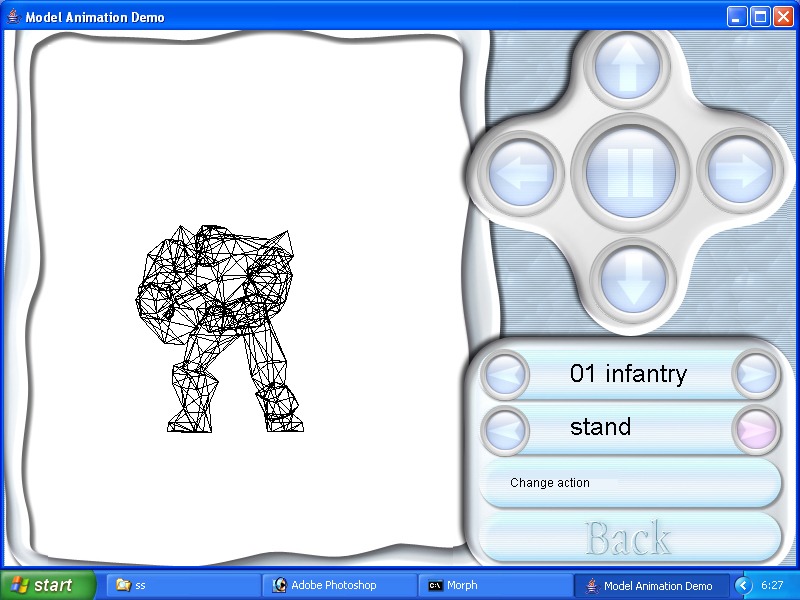
Polygon Morphing & Quake II Model Animation
Java application that demonstrates polygon morphing between arbitrary shapes and renders animated Quake II .md2 models. Wrote a custom C++ converter for the binary model format. Below: the polygon morphing half, ported to canvas. Draw two polygons, hit play.
JavaC++3D GraphicsMD2Now: HTML5 Canvas
↓ javaMorphFull.zip (1.2 MB — original w/ MD2 model viewer)
Polygon morphing and Quake II model viewer — original 2004 screenshot

Original 2004 screenshot — the Photoshop-designed Java Swing UI with the joypad rotation controls and pipe-switcher buttons.

Draw polygon 1 click to add vertex · right-click to close
60
40

Linear interpolation between polygons, padded by adjacent-duplicate to balance vertex counts — the same technique Quake II uses between MD2 keyframes.

Loading model…

Actual Quake II MD2 player models — 315 vertices, 590 triangles, 198 frames, 20 animations. Drag to rotate. Wireframe with backface culling and depth-fade.

2003
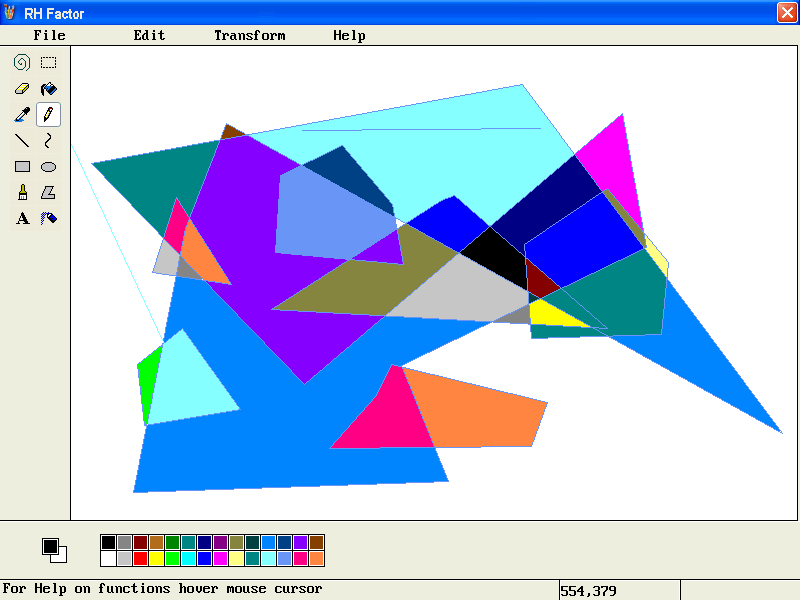
R H Factor
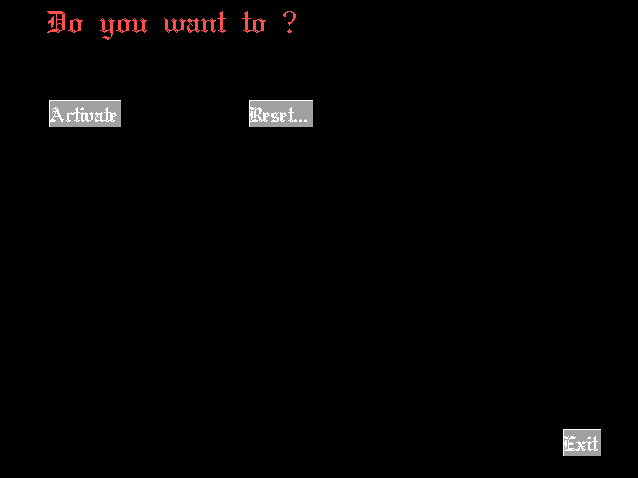
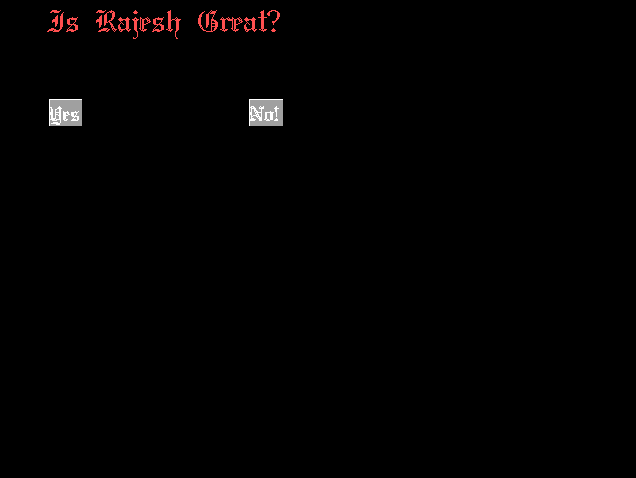
A full MS Paint clone for DOS. Raster graphics editor with brushes, shapes, color picker, undo, and icon editor. 20+ source files, all in C++ with raw graphics primitives. The DOS exe ran against FastGraph's SVGA driver; the in-browser build below compiles the original 2003 sources against a small SDL2 shim and ships as wasm.
C++DOS GraphicsRasterNow: SDL2 + wasm
↓ rhfac.zip (190 KB)→ run in browser
R H Factor paint clone
2003
Phaser
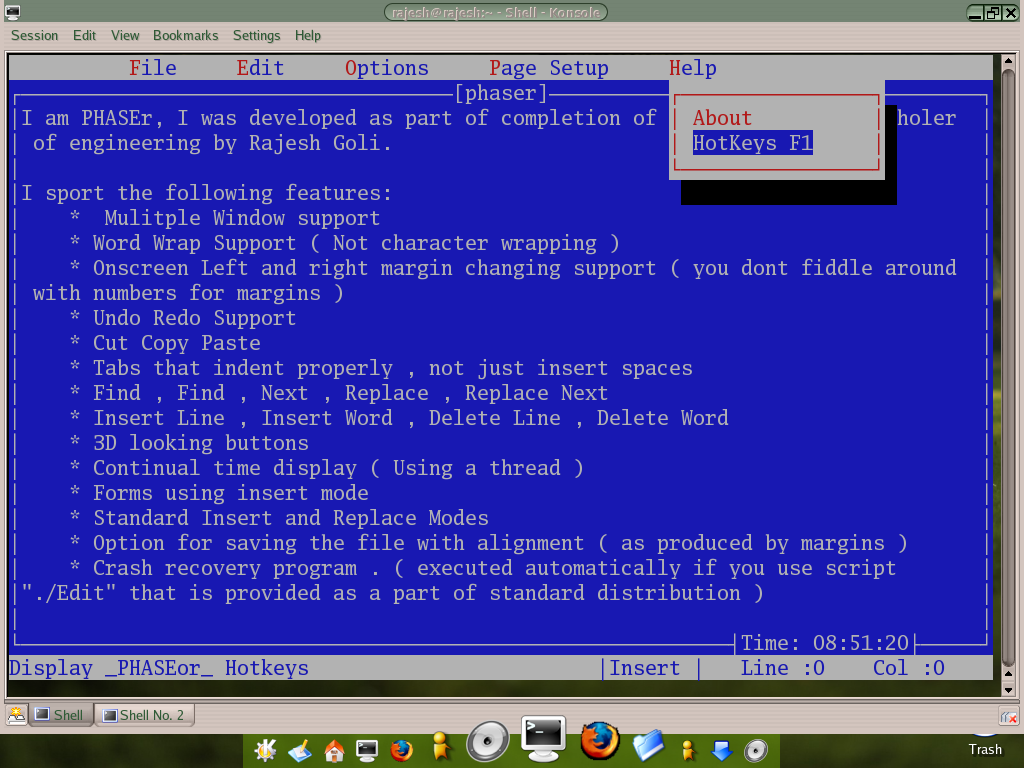
A text editor for Linux built on ncurses. Syntax highlighting, macros, file management, status bar. 56K of C++ in the main file alone. Buggy but feature-laden — as the description honestly noted.
C++ncursesLinux
↓ phaser.zip (266 KB)→ run in browser
Phaser text editor
2002
ParticleFX
A particle physics simulation. Renders particles under the effect of forces — gravity, repulsion, attraction — in real time. Built for fun, not a class assignment. Below: a faithful port to HTML5 canvas running the same s = ut + ½at² from PixFX.cpp.
C++GraphicsPhysics SimNow: HTML5 Canvas
↓ pixfx.zip (118 KB — original DOS source)

320×200 mode 13h, scaled. Original ran at full DOS speed; this honors the same time-step (timedelay=0.5).

Technical writing from the era
of hand-rolled HTML.

Written for a site built with PHP and Smarty templates. The kind of tutorials that existed before every answer was on Stack Overflow.

Systems

Interrupts, IVT & ISRs

Deep dive into interrupt vector tables, interrupt service routines, and how DOS handles hardware interrupts. One of the most visited pages on the original site.

C Programming

Progress Bars in C

How to implement a progress bar in a non-multithreaded DOS environment. Multiple approaches to a problem that modern programmers never have to think about.

Networking

To Route or to Switch

The fundamental difference between routing and forwarding — explained from first principles without assuming any networking background.

Web Dev

Separation of Content and Design

The case for separating content from presentation. Written in 2004, a year before Django and Rails made MVC mainstream. The principle hasn't changed.

Browse all 32 articles →

75 C programs
for an OS that no longer exists.

TSR hacks, keyboard interceptors, Explorer exploits, encryption tools, ASCII art generators — all written for DOS and Turbo C. A time capsule from when you had to manage your own memory and interrupts were your API.

10 "Cool Ones" 4 TSR Programs 12 Custom Headers 23 Syllabus Programs 14 Utilities

"I started by training a neural network to recognize faces on a Pentium. I ended up running teams of AI agents that build software while I sleep."

C++ → Win32 → Neural Nets → Amazon AGI → AI Agent Teams