Warning: This post contains pictures of very large dimensions. The collective size of all the picures in this post is 864 Kb. Please proceed only if such big pictures dont deter you :-P.
Tonight I spotted Saturn in the night sky and photographed it. Here is the picture showing saturn:
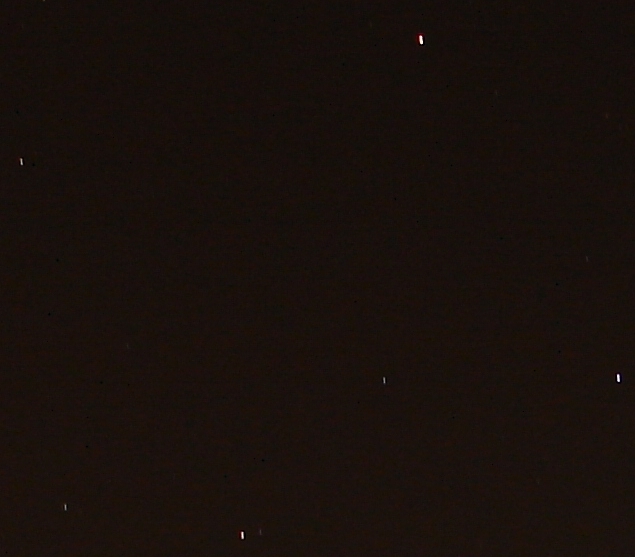
The bright object on the right top corner is Saturn, the right bottom one is a star called Regulus, the left bottom one a binary star system called Algieba, the left top one yet another star called Algenubi.
How did I spot it? Well, first I spotted the Orion constellation, which is about the easiest thing to spot in the night sky, because the three stars that form its 'belt'. Here is a picture of it I took:
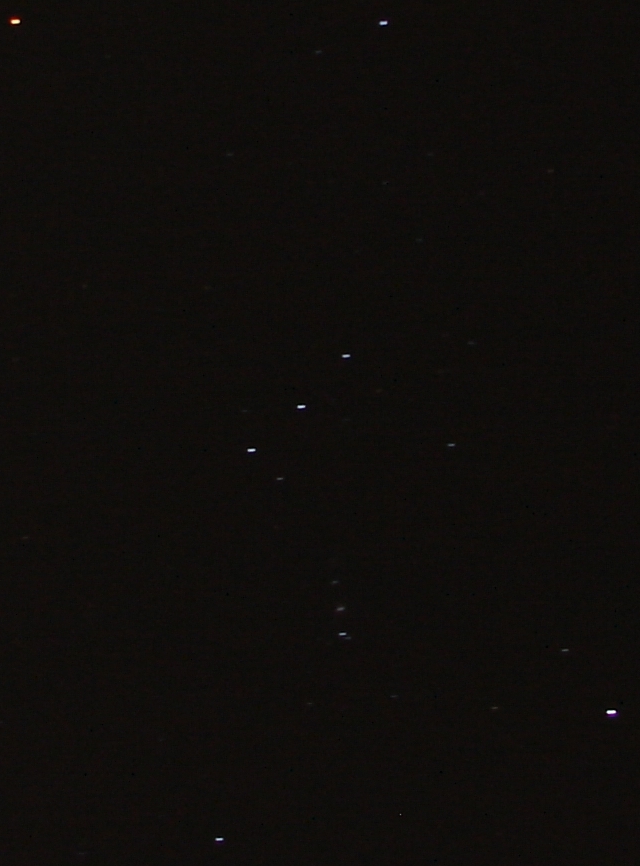
The orangish star on the top left is a red giant called Betelguese, the top right one is Bellatrix, the bottom right one Rigel, and the bottom left is Saiph. The stars (or systems of stars) that make its 'belt', from left to right, are Alnitak, Alnilam and Mintaka. The 'sword' of Orion is only very slightly visible, the topmost of it being faintest.
From Orion, it was easy to get to Sirius, and from Sirius to Procyon, and these together with Saturn made a very bright and very obtuse angled (at Procyon) triangle in the sky.
Here is a picture of Procyon and Sirius:
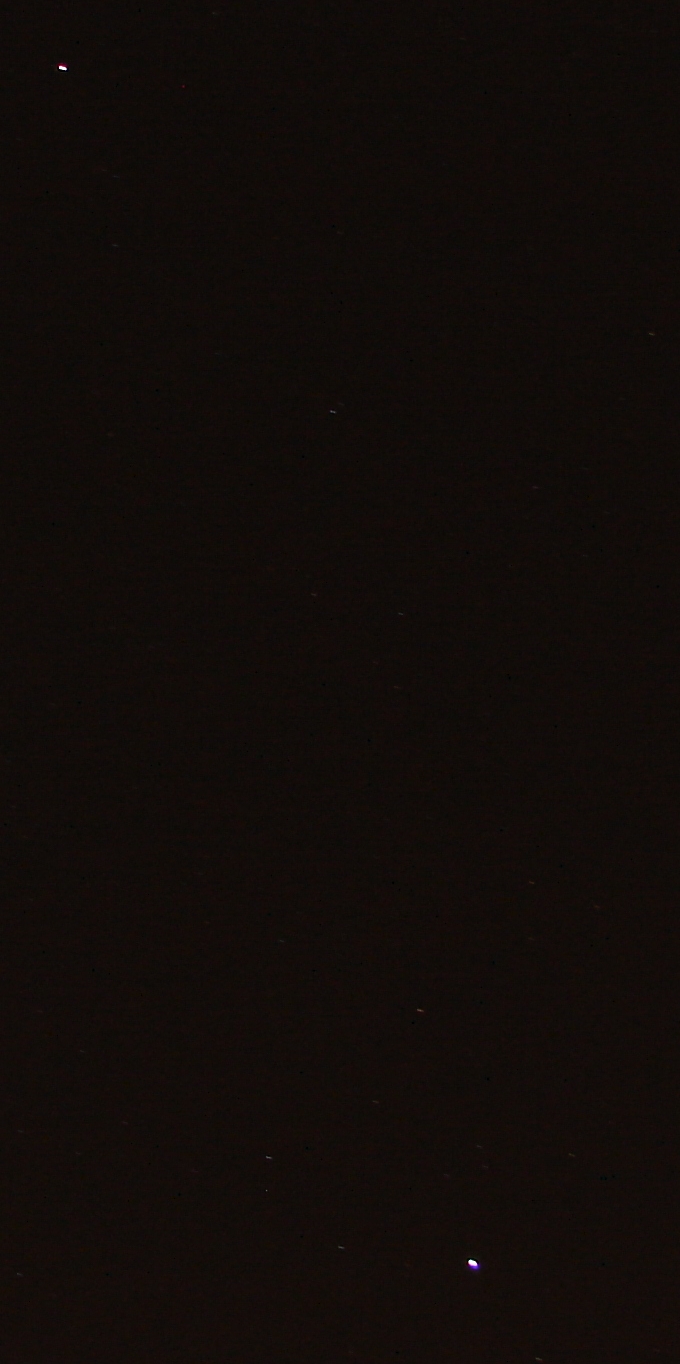
The bright object on bottom right is Sirius and the star on top left is Procyon.
Why do the stars in the picture appear as short line segments instead of points of light? Well, I set the exposure time to a very large value so that the objects could appear bright. As it turns out, the stars have moved slightly in that time, producing streaks of light.
It is very hard to see any slightly less luminous object in the night sky due to immense light pollution here in Bangalore.
All this might have been soporific for some of you, but I hope it roused the sense of wonder that it did for me in atleast some of you. A light wave that travelled all the way from whatever it is that I am seeing to here unimpeded - being forced to collapse its waveform in the CCD of my camera is sort of a wonderous thing, isn't it? :-)
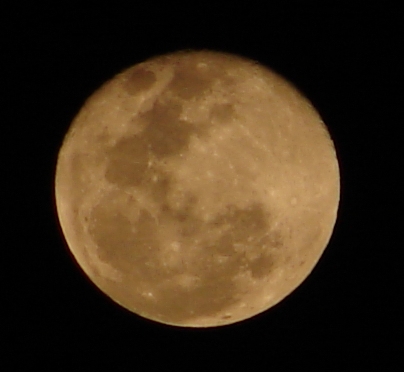
A bonus ;-) - here is a picture of the full moon I took two days ago:
Dilip & Harish
Dilip, yeah it was earth that moved, rather rotated about its axis. The exposure time was about 30 seconds and the zoom was 12x optical.
Well the cause of stars 'streaking' might have been because of
1) Movement in the tripod OR
2) Twinkling of the stars OR
3) Because they 'moved' in the night sky.
As a control, I photographed a house at the end of road with a star above it. The star appeared 'streaked', but the house was not 'smeared'. Thus 1 is ruled out.
When I took pictures with multiple stars in it, they all appear to 'streak' in a single direction. Twinkling of all stars in different areas cannot be that symmetric. So 2 is ruled out. The only explanation left is that the stars have 'moved' in the night sky :-)
Harish, there'll always be things that you dont know. ;-)